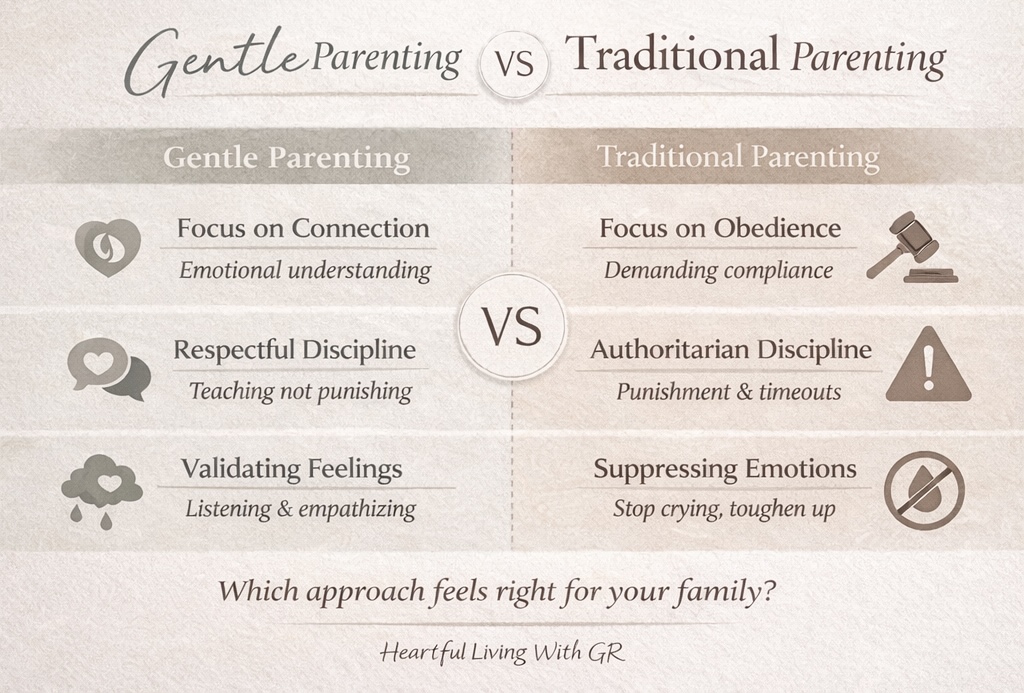

When I first became a mom, I didn’t sit down and consciously choose a parenting style.
Like most parents, I parented the way I had seen parenting done.
I corrected.
I raised my voice when I was overwhelmed.
I believed that obedience meant I was doing a good job.
I thought discipline meant control.
And then… motherhood humbled me.
Raising my two boys taught me something I wasn’t prepared for:
Parenting is not about shaping children into “well-behaved” humans.
It’s about guiding them while learning to regulate ourselves.
That realization slowly led me to explore the difference between traditional parenting and gentle parenting—and eventually, to find a balance that feels more heartful, peaceful, and sustainable for our family.
This post isn’t about telling you which style is “right.”
It’s about helping you understand the difference—so you can choose what aligns with your values, your nervous system, and your child.
What Is Traditional Parenting?
Traditional parenting is what many of us grew up with.
It often emphasizes:
- Obedience over understanding
- Authority over connection
- Discipline through punishment
- “Because I said so” as a final answer
In traditional parenting, adults are seen as the unquestioned authority. Children are expected to listen, comply, and behave—often regardless of how they feel.
Common phrases sound like:
- “Stop crying.”
- “Go to your room.”
- “You know better than that.”
- “If you don’t listen, there will be consequences.”
And to be clear—traditional parenting doesn’t come from bad intentions.
Most parents using this approach are doing the best they can with:
- The tools they were given
- The stress they are carrying
- The lack of support they often feel
Traditional parenting was built in a time when emotional needs were rarely discussed, and survival mattered more than emotional expression.
What Is Gentle Parenting?
Gentle parenting often gets misunderstood.
It is not permissive parenting.
It is not letting children “do whatever they want.”
It is not never saying no.
Gentle parenting is rooted in:
- Emotional awareness
- Mutual respect
- Connection before correction
- Teaching instead of punishing
At its core, gentle parenting asks:
What is my child communicating through their behavior?
Instead of focusing only on behavior, gentle parenting focuses on the emotions underneath the behavior.
Key principles include:
- Validating feelings (without validating harmful behavior)
- Setting clear, consistent boundaries
- Teaching emotional regulation through modeling
- Prioritizing long-term emotional health over short-term compliance
The Biggest Difference: Control vs Connection

The biggest shift between traditional and gentle parenting is this:
Traditional parenting asks, “How do I stop this behavior?”
Gentle parenting asks, “What does my child need right now?”
One focuses on immediate results.
The other focuses on long-term emotional development.
When my child has a meltdown:
- Traditional parenting would tell me to stop the behavior quickly.
- Gentle parenting invites me to pause, breathe, and respond with intention.
That pause—though difficult—has changed everything in our home.
Discipline: Punishment vs Teaching
Traditional Discipline
- Time-outs
- Loss of privileges
- Fear-based consequences
- Shame or guilt used as motivators
This approach often works short-term.
Children comply—but not because they understand.
Gentle Discipline
- Natural consequences
- Emotional coaching
- Repair after conflict
- Teaching skills instead of enforcing fear
Gentle discipline asks:
What skill is my child missing right now?
Is it patience?
Impulse control?
Emotional regulation?
Because children aren’t born knowing how to manage big feelings.
They learn by watching us.
“But Gentle Parenting Is Exhausting…”
Yes. It can be.
Gentle parenting requires:
- Self-awareness
- Emotional regulation
- Breaking generational patterns
- Responding instead of reacting
And as a mom—especially on tired, overstimulated days—I won’t pretend it’s easy.
There are days I still raise my voice.
Days I feel overwhelmed.
Days I wish parenting came with a pause button.
But gentle parenting doesn’t demand perfection.
It asks for repair.
Apologizing.
Reconnecting.
Trying again.
That’s where the real growth happens—for both parent and child.
Why I Chose a More Gentle Approach
I didn’t choose gentle parenting because it was trendy.
I chose it because:
- I didn’t want fear to be the reason my children listened
- I wanted my boys to feel emotionally safe with me
- I wanted our home to feel calm—not controlled
- I wanted to parent from intention, not exhaustion
I noticed something powerful when I shifted my approach:
My children started opening up more.
They began naming their feelings.
Our conflicts softened.
Our connection deepened.
And most importantly—I became more present.
Gentle Parenting Is Also About You

This part doesn’t get talked about enough.
Gentle parenting isn’t just about raising emotionally healthy children.
It’s about healing the parent, too.
It asks us to:
- Unlearn what no longer serves us
- Sit with discomfort instead of silencing it
- Respond to our children the way we wish we were responded to
That can feel heavy—but it can also feel incredibly freeing.
You Don’t Have to Choose One Box
Here’s the truth I’ve learned:
You don’t have to be strictly “gentle” or strictly “traditional.”
Parenting is not black and white.
It’s nuanced.
It’s personal.
It evolves.
You can:
- Hold boundaries and be compassionate
- Say no and validate feelings
- Teach respect without fear
The most heartful parenting style is the one that:
- Feels aligned with your values
- Supports your mental health
- Honors your child’s emotional world
- Allows room for growth and repair
A Heart-to-Heart From One Mom to Another
If I’m being honest, there was a time when I thought good parenting meant having everything under control.
The kids.
The emotions.
The behavior.
I believed that if my children listened right away, I was doing something right.
But motherhood has a way of gently (and sometimes not so gently) teaching us otherwise.
What I’ve come to realize is that the moments that truly matter aren’t the ones where everything goes smoothly. They’re the messy ones. The moments after the tears. The quiet reconnections. The times I sit on the floor and say, “I’m sorry—I lost my patience.”
Gentle parenting didn’t suddenly make my days calm or easy. I still have hard moments. I still get overwhelmed. I still raise my voice sometimes—especially on long days.
But it changed the feel of our home.
I don’t try to be perfect anymore. I try to be present.
When I mess up, I repair. When my boys struggle, I listen. And when things feel chaotic, I remind myself that connection matters more than control.
What I want most is for my children to know they are safe with me—not just when they’re calm and happy, but when they’re angry, tired, or falling apart.
Some days, gentle parenting looks like patience.
Other days, it looks like taking a deep breath and trying again.
And honestly? Both count.
If you’re reading this and wondering if you’re doing enough—if you’re questioning your parenting or trying to unlearn old patterns—please hear this:
You’re not failing.
You’re growing.
And choosing to parent with intention, compassion, and awareness—even imperfectly—is powerful work.
You’re not alone in this.
Final Thoughts

Gentle parenting isn’t about raising “perfect” children. It’s about raising emotionally secure, confident humans.
Traditional parenting taught us how to control behavior. Gentle parenting teaches us how to build connection.
And in my experience as a mom to two boys connection has always been the thing that lasts.
You can find more reflections on gentle parenting, present motherhood, and creating a peaceful home by browsing the posts in the Motherhood and Mindful Living sections.
Leave a Reply